
In all those moments, I had the privilege of ministering to the students, I felt empty. Despite serving those four years, I felt I hadn’t grown at all. I led these children with my heart closed to God. I struggled, instead, with seeking approval and purpose in my community, instead of fully pursuing Him.
When I first started processing my abuse, my relationships with the men in my life suffered. […] My anxieties and fears sent me into panic attacks every time one of them asked to get together.
And while I landed my first management role, my husband and I found out that we were expecting our first child. When I told my employer that I was expecting, he dropped his drink and said, “What did I do wrong?”

I was pregnant with my third baby, but still not a child in my arms. Five weeks of carrying this precious soul and holding onto a thread of hope that perhaps this would be the one.

In the summer of 2004, I was sitting on a park bench with a view of the city’s skyline across from me, and these words filled my heart: “If not you, who? If not now, when?” … I could see that God was at work as He quietly stirred my heart, asking me to ponder His words more deeply while I discerned for the next chapter in my life.

After 55 years, I had hit a wall. I was so uncomfortable with the chaos and craziness around me – I had lost my usual sense of peace and calm. Something was stirring inside me, drawing me away from my usual way of life.

For most of my life, I experienced unexpected and difficult trials that left me with hurts, fears, and growing pains that almost crippled me at times. But God carried and protected me through it all and that is what I want to share with you.

For a large part of my childhood, I was a quiet girl. I didn’t contribute much in class due to my intense shyness and would squirm in fear if I were called on. I preferred to recede into the walls when necessary and would find it difficult to even string together a sentence at times. I would rather go unnoticed; it seemed safer that way.

To say this year was an emotional roller coaster is an understatement. I was stretched and challenged in many ways, but the ultimate challenge was and in many ways still is to really believe I am a daughter of God and thus, I have reason to hope.

We all are in need of healing. I want to tell you a story of suffering and healing; a story of how Scripture brought me back to God. Two years ago, my husband and I journeyed towards first-time parenthood blissfully unaware of the challenges bringing a child into the world could hold.

Growing up, one of the people I admired the most was my mom. Her character, her faith, her relationship with my dad—if I wanted to be like anyone on this Earth, it would be my mom. Most of all, I dreamed of having a marriage like hers.

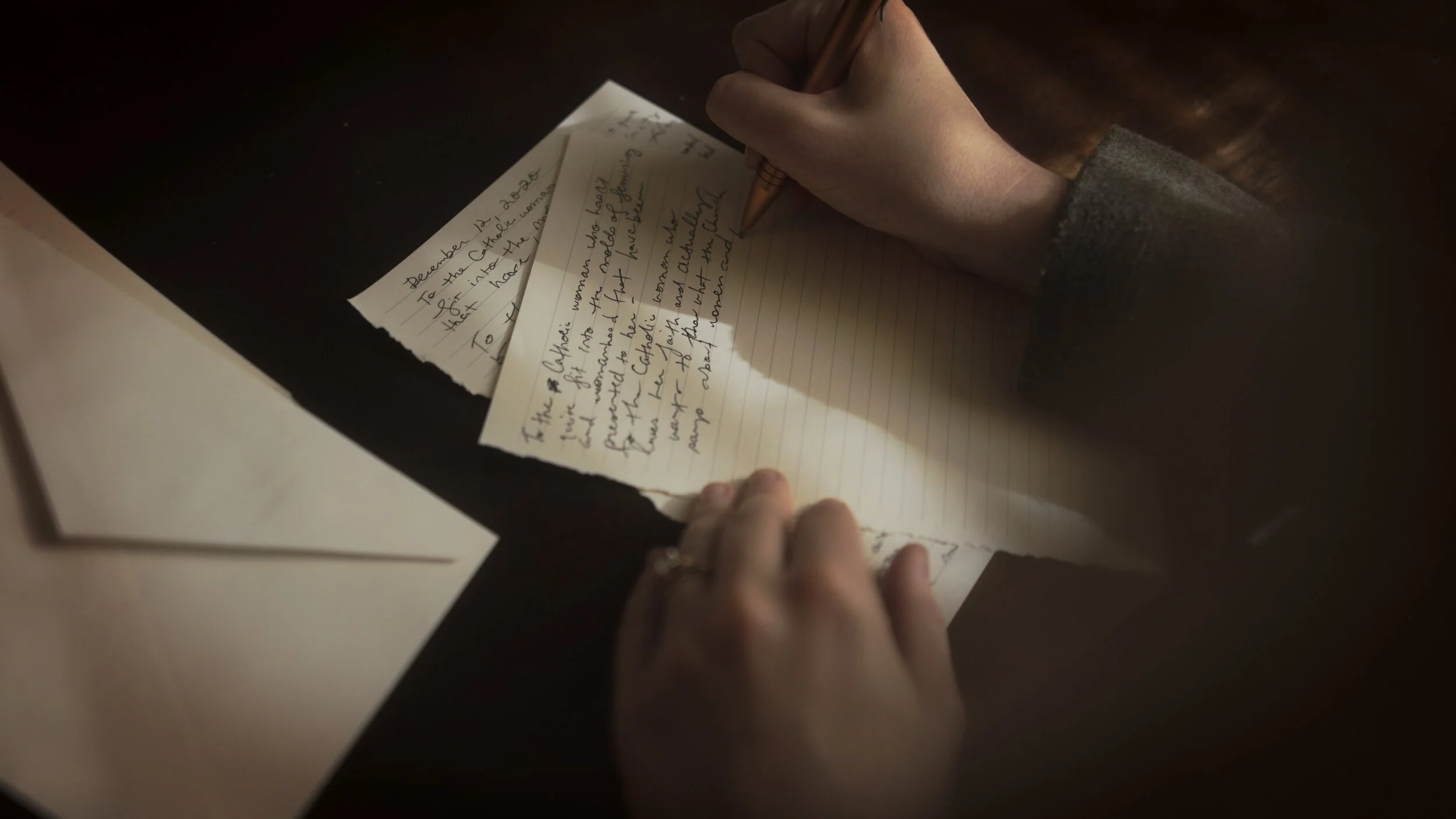
I am not the Catholic woman who has had it all together. I am the type of individual that holds too many opinions, who is too loud, feels too deeply, and is constantly trying to get this “faith thing” right. I think that before social media, I knew I was somewhat an outsider in general, but it was once I joined that I felt that thought was perpetuated even more -- and not just by me, but by others, as well.

If someone told me 10 years earlier that I would eventually be married and a stay-at-home mom, I would have been angry. It was not the type of life I imagined myself having when I left the Church, and God, in pursuit of worldly things. I left the Church in pursuit of the lies our world tells us about sexuality, gender, and lack of commitment to others.

Growing up, most of my Catholic experiences were with groups of people who looked like me and talked like me. I attended Spanish masses often, my youth groups were mostly Hispanic, and the Catholic school I attended was a mostly Hispanic and Black Community.

Rachel shares how Christ speaks to her in the midst of discouragement when hope seems most far off.

Mariana encourages our hope to transcend earthly goods, no matter how good they may be, and instead place it in the certain promises of Jesus.

Kristen speaks to the transformative power that a hope rooted in the person of Jesus can bring to seemingly overwhelming circumstances, especially when it involves the whole of our present experience.

Christians are called to be people of hope. Hope is a theological virtue in the Catholic tradition and appears as a theme numerous times throughout the Old and New Testament. It clearly holds a place of importance in the spiritual life but knowing what exactly that place is can be a challenge, especially with the variety of ways that the term “hope” is used in our day-to-day…

McKaela reflects on the ways that hope has encouraged her to see life as a grand adventure even in the midst of seemingly mundane times.

Just last year I began being more intentional with my time and actions during Advent. A friend offered some beautiful insight to me saying that “while Lent is a time to prepare for the death of Christ, similarly Advent is a time to prepare for the birth of Christ.” Since then I have tried to be more intentional with my time.

I sometimes try to picture how Mary and Joseph would have felt in their anticipation for Jesus’ birth. I can picture them being more nervous than most parents because they knew their son was actually the Son of God! That is serious pressure, but they both bore it with such grace.

I think it’s safe to say that Advent is usually a very busy time for all. However, unfortunately, it tends to be busy with everything else but the soul. Society has done a great job at distracting us. It prepares us for a day rather than a person and before we know it Christmas is “over.”

So this Advent, while awaiting the coming of Jesus Christ with Mary, I am also awaiting – with the disciples – the knowledge of the path that the Lord is calling me to. Together, Mary and the disciples show how to wait – faithfully, trustingly, while also continually preparing to receive Him.

Usually, Advent is seen as a time to prepare. We begin hanging up all the decorations and participating in all the activities, both religious and not. Many Catholics can even feel compelled to identify major problems, worries, or fears in our lives so that we can give ourselves a reason to enter into this season in a big, meaningful, or dramatic way.

Stewardship has been a call on the human heart since the genesis of man: “Be fruitful and multiply; fill the earth and subdue it” (Gen. 1:28). This is a call not only for our first parents, but for us as well. We are each called to build up the Kingdom through the particular gifts God has given us –– whether monetarily, ability, or circumstantially.

Although we may not be able to give big dollar amounts, the Lord asks us to bring to the altar what we have to offer, and he will multiply them. For example, when I bring $5 to the table, and you bring $5 to the table, our $5 becomes $10, and just like that, our gifts have multiplied. But this only happens when we give as a community. All of us must offer our gifts at the altar, not just some.

I firmly believe that the most fun any of us will ever have with our money is to give it away and be a blessing to our family, friends, community, and world. Our unique personalities SHOULD be an intimate part of the type of giving we do. What causes, movements and ministries do you want to see furthered in our world? We should absolutely be giving to those personal reflections of our hearts, in addition to giving to our local parish and diocese.

As a Catholic woman, God has granted me gifts and resources which He hopes I will care for and nurture. For a long time, I viewed these gifts and resources as normal elements of life—family, friendship, money and time doing things I enjoyed like being in nature. Only when I intentionally spent time in prayer and considered these gifts, did my perception about them change.

God has pursued, is pursuing, and will always pursue me more than I pursue Him. I’ve looked for Him in people, food, and adventures and at some point, I always end up weary and disappointed. But He continuously pursues me as I am, seeking me in my doubts and insecurities. He has led me to the desert many times and has spoken persuasively, encouragingly, and lovingly to me (Hosea 2:16) to the point that even when I try to ignore Him, I know that He is there.














There’s a word in Welsh, “hiraeth,” that embodies what this new normal meant for me. The word hiraeth means a homesickness or nostalgia for a home that you can’t return to, or maybe never was. It is a deep longing for something that no longer exists. And that feeling – of a longing that can’t be fulfilled, a thirst that can’t be slaked – is exactly what it felt like, trying to “move on” from the grief, to find a new home.